Oct 7, 2026Guides
Outdoor Shading for Restaurants, Hotels and Resorts: Specifying Windproof Roller Blinds
Specify windproof roller blinds for hospitality terraces and outdoor dining across 8 models, covering spans up to 14 m with motorized and manual controls.
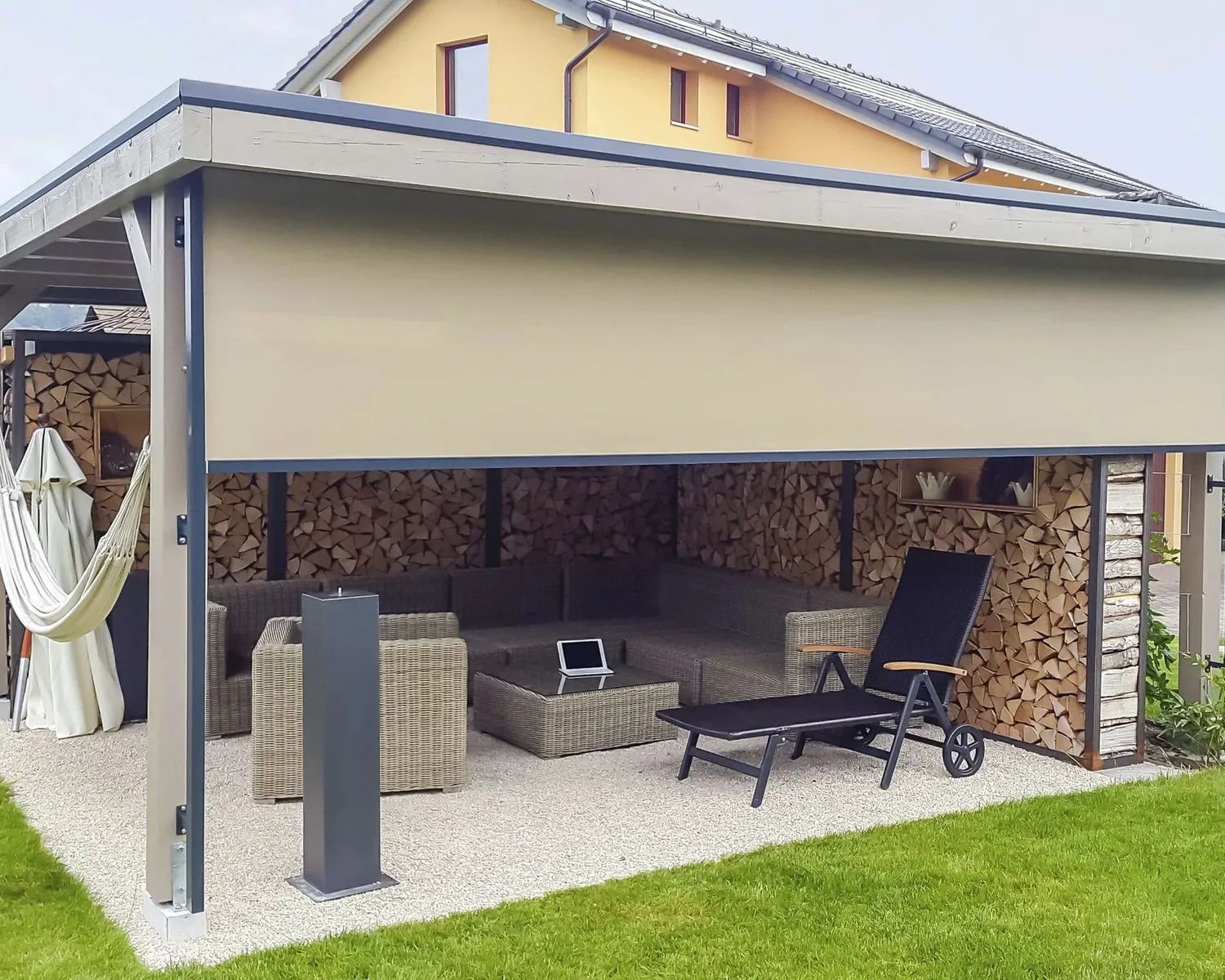
Specifying outdoor shading for restaurants, hotels and resorts means balancing the outward view and solar glare across different facade openings. Windproof zip-track roller blinds secure fabric edges inside aluminium side tracks along the full drop. Specifiers can coordinate motorized systems spanning up to 14 m and manual systems without electrical wiring to standardise exterior facade management across hospitality venues.
What Changes When a Terrace Serves Guests
Commercial hospitality environments—including restaurants, resorts, outdoor dining areas, outdoor venues, terraces, and patios—operate under distinct functional demands compared to private residential spaces. When outdoor dining areas serve guests throughout extended breakfast, lunch, and dinner services, exterior shading systems face continuous exposure to changing solar angles and coastal or open-air breezes.
In hospitality settings, a standard drop or cable-guided system leaves the fabric edges free, so the fabric can lift and flap in the wind right above the seating area.
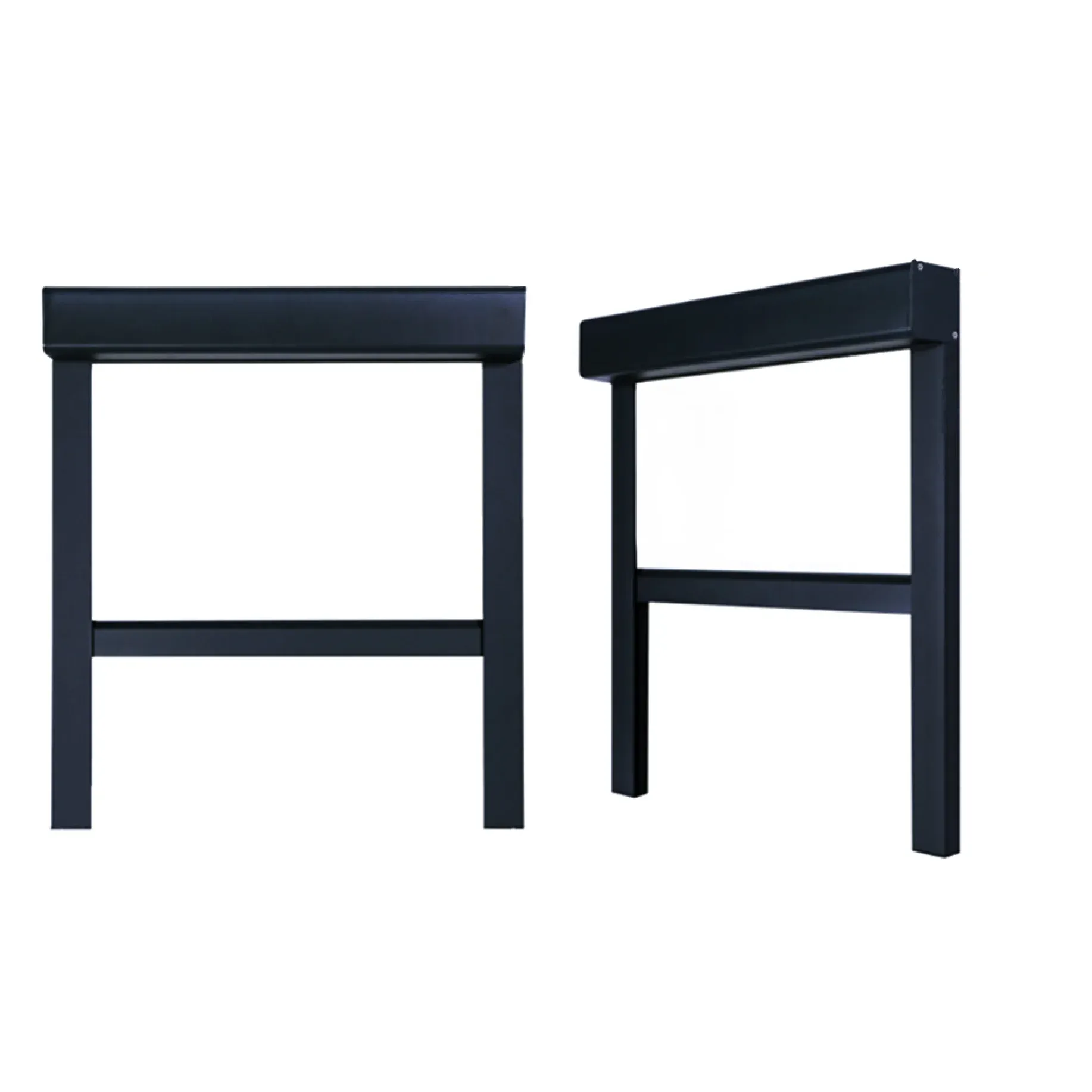
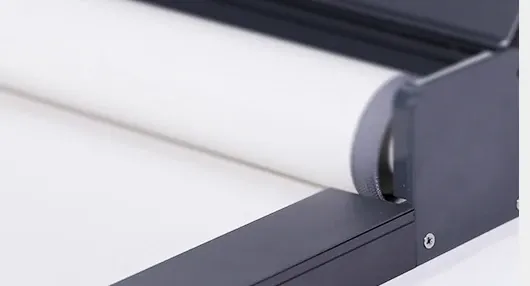
Zip-track windproof roller blinds resolve these issues through an integrated mechanical design. Welded zipper teeth along both fabric edges run continuously inside aluminium side tracks. As detailed in the eziptrack system features, this mechanical lock holds the screen flat, resists flapping, and keeps the fabric edges captured in the side channels along the full drop. Furthermore, the one-piece aluminium alloy casing has no visible seams on the face, providing a clean, architectural profile that integrates into modern hospitality facades.
When specifying outdoor shading for hospitality properties, contractors and specifiers must address several key requirements:
- Holding the fabric edges in fixed side channels along the full drop.
- Selecting fabric openness rates that cut solar glare while preserving the outward view.
- Coordinating different facade dimensions across terraces, dining bays and pergolas.
- Establishing standard staff operational routines for deploying and retracting systems during daily service and severe weather.
Sizing a Facade Opening by Opening
Hospitality facades are rarely uniform. A hotel or restaurant layout often combines compact access passages, regular dining bays, medium-span sections and expansive open-air terraces. Sizing an outdoor shading project requires surveying each structural opening independently and mapping the dimensions to the appropriate blind model from the 8 available product lines.
The eziptrack range covers these span bands:
- Narrow and Compact Bays: For individual openings and narrow dining bays, the ZT90 motorized windproof roller blind accommodates widths from 0.65 to 2.6 m with heights up to 2.5 m. It is driven by an AG40RE-10/14 tubular motor (10 Nm, 110–230 V AC) and is available in white, coffee, and dark grey casing finishes. For slightly larger standard openings, the ZT110 model covers widths from 0.68 to 3 m and heights up to 3.2 m with the same 10 Nm AG40RE motor configuration.
- Intermediate Dining and Patio Spans: For medium outdoor dining zones and pergola sections, the ZT150 motorized windproof roller blind supports spans from 0.85 to 5 m in width and drops up to 5 m, with an AG50RM motor (15 Nm, 110–230 V AC). Where dual operation is useful, the ZT170 2-in-1 model covers spans up to 5 m and heights up to 4 m, combining motorized and manual operation (AM45 motor, 20 N, 110–240 V AC).
- Expansive Terraces and Frontages: For large hotel terraces and wide restaurant frontages, the ZT180 large-size motorized windproof roller blind spans widths up to 14 m with drops up to 7 m, using an AM45 motor (20 N, 110–240 V AC).
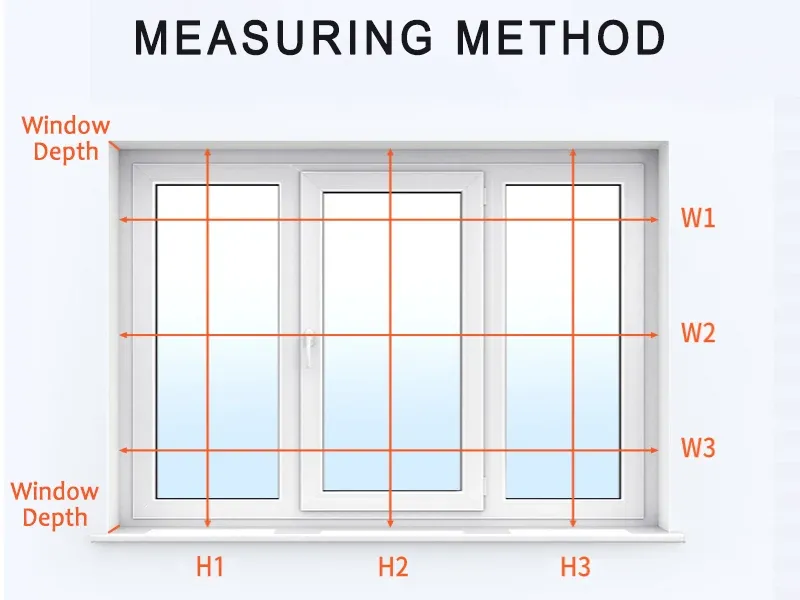
Accurate on-site surveying is critical before submitting project orders. As outlined in the eziptrack measuring method guide, specifiers record three width points (W1 top, W2 middle, W3 bottom) and three height points (H1 left, H2 middle, H3 right), then apply the guide's formulas for the inside recess and outside or ceiling installations.
Fixed side tracks mean each unit is produced to the measured opening rather than adapted on site.
Coordinating Many Openings in One Project
A hotel or restaurant project often involves many individual facade openings that need to be planned together. Projects with multiple windows or whole-house shading schedules are welcome.
Motorized eziptrack units are controlled by remote or over Wi-Fi through the TUYA app.
The motorized range lists S4 min continuous operating time and an operating range of -10 to +60 °C.
A project can also mix the two: motorized units where power is available, and manual units on openings without it. A detailed comparison is available in our guide on motorized vs manual outdoor roller blinds.
The Double Layer motorized windproof roller blind pairs two fabric layers in one motorized unit, covering widths from 1 to 4 m and heights up to 3 m with an AM45 motor (15 N, 110–230 V AC).
Retraction Routines During Service Hours
For hospitality management, what matters is the wind rating the manufacturer states: grade 8 for motorized models and grade 10 for manual models.
However, commercial operators must recognize that outdoor roller blinds function as solar shading and weather-moderating systems rather than permanent structural storm barricades. As explained in our engineering analysis of outdoor roller blind wind ratings and grade 8 performance, a clear operating routine for staff helps protect both the shading equipment and the property around it:
- Daily Opening Routine: At the start of service, staff lower the blinds to the position that suits the day’s solar angles and guest comfort.
- Dynamic Weather Management: When regional weather alerts indicate severe storm fronts, gale conditions, or sudden high-velocity gusts, hospitality staff should fully raise and retract all blinds into their casings. Retracting the blinds during extreme weather protects the system.
- End-of-Service Protocol: At the conclusion of evening dining hours, or when outdoor terraces and patios remain unattended overnight, all outdoor blinds should be routinely retracted into their protective casings.
The stated fabric tear strength is warp ≥2,650 N/5 cm and weft ≥2,450 N/5 cm, and the fabric is stated as anti-wrinkle and anti-tear. The side-rail system holds the screen flat and resists flapping.
Fabric Choices for Guest-Facing Terraces
Choosing the correct fabric openness rate is fundamental when specifying outdoor shading for terraces that serve guests. The openness rate is the percentage of open weave or hole area relative to the total fabric area. The chosen openness rate directly determines the balance between solar glare reduction, daylight transmission, heat mitigation, and outward view clarity.
- Exposed Elevations (3% Openness): For outdoor dining areas and western or southern elevations that take intense afternoon sun and high solar gain, 3% openness is the usual choice. The PW100 composite fabric series features a 30% polyester and 70% PVC weave, with a stated weight of 565 g/m² (±5%) and a thickness of 0.70 mm (±5%). Its dense weave cuts glare and heat, and at 3% a faint outline of the outside stays visible.
- Covered Terraces with Panoramic Views (5% Openness): For covered terraces and garden patios where the outward view matters more than maximum heat blocking, 5% openness is the common baseline. The PW300 series is a fibreglass and PVC weave at 600 g/m² and 0.80 mm thickness.
- Higher Openness (6% to 30%): Higher rates admit more daylight and keep a clearer outward view; options include 6% (PW400 series, 495 g/m², 0.62 mm), 10%, 14% (PW500 series, 360 g/m², 0.45 mm) and 30%.
- Blackout Configurations (0% Openness): Blackout fabrics—including the PW200 series (420 g/m², 0.65 mm) and PW600 series (650 g/m², 0.53 mm)—are listed as available for motorized models. Blackout fabric blocks all light and both sightlines, for spaces where nothing should show through.
All eziptrack screen fabrics carry a stated B1 fire-retardant classification. The fabric is also stated at ISO 105 B02 Grade 8 for colour fastness to light — a light-fastness measure on a different scale from the wind grades. The composite fabrics also feature stated water-proof, oil-proof, wear-resistant, anti-wrinkle, anti-tear, and anti-sun characteristics.
Fabric rolls are supplied in 200, 250, 300 and 320 cm widths, and the colour card lists 24 colour codes across 6 fabric series. The complete 30-page PDF colour card is free to download, and physical fabric swatch books can be ordered by email enquiry.
Manual Options Where Power Is Not Available
Where a terrace, pergola or balcony has no electrical supply, the range includes two manual zip-track models with the same side-track fabric retention:
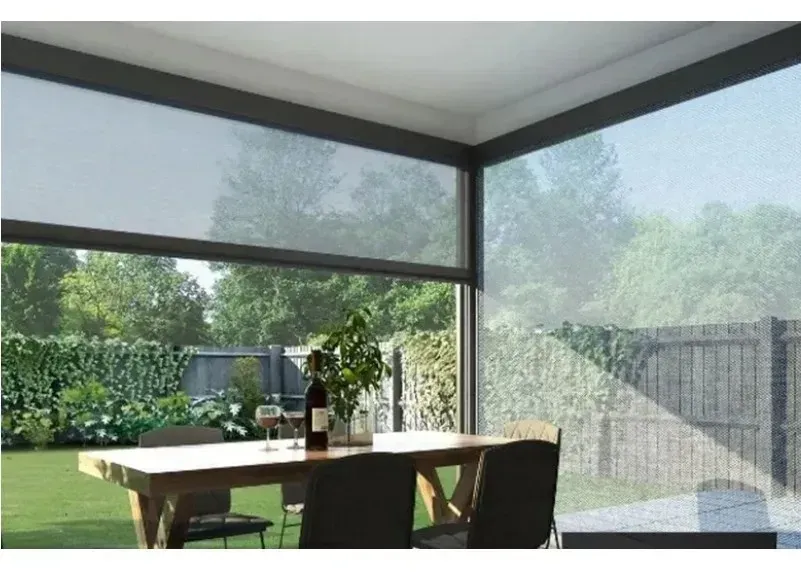
- Hand Crank Manual Windproof Roller Blind: The Hand Crank manual windproof roller blind is operated via a hand rocker, and accommodates openings with widths from 500 to 4000 mm and heights from 1500 to 3000 mm.
- Cordless Spring Manual Windproof Roller Blind: The Cordless Spring manual windproof roller blind uses a wireless spring: the blind is positioned by hand from the bottom rail. It supports opening widths from 1200 to 4000 mm and heights up to 3000 mm.
Both manual models use aluminium alloy side tracks and bottom rail, with the fabric edge held inside the side rail along its full length. The manufacturer states windproof grade 10 for both.
Casing colours for both manual models are dark grey, white and coffee, and both are catalogued with shading and light-transmission fabric categories.
Hospitality Project FAQs
How wide can a single outdoor roller blind span on a restaurant terrace?
For wide restaurant dining terraces, the ZT180 large-size motorized model covers continuous spans up to 14 m in width with drops up to 7 m, powered by an AM45 tubular motor (20 N, 110–240 V AC). For intermediate spans, specifiers can select the ZT150 model for widths up to 5 m and heights up to 5 m, or the ZT90 (0.65 to 2.6 m width) and ZT110 (0.68 to 3 m width) for smaller dining bays. Sizing is planned opening by opening to match structural facade posts.
How can outdoor blinds be fitted if there is no electrical wiring on an existing patio?
Where existing hospitality terraces or remote resort pergolas lack electrical wiring, specifiers can deploy manual zip-track systems. The Hand Crank model spans 500 to 4000 mm in width and 1500 to 3000 mm in height via a hand rocker, while the Cordless Spring model spans 1200 to 4000 mm in width and heights up to 3000 mm via a wireless spring mechanism. Both manual models feature a manufacturer-stated windproof grade 10 and operate independently of electrical power supplies.
How are multiple facade openings coordinated across a large hotel or resort project?
Projects with multiple windows or whole-house shading schedules are welcome: send the width and height of each opening, and the team confirms the configuration and provides a quotation. Motorized units are operated by remote or through the TUYA app.
When should hospitality staff retract the blinds?
While motorized models carry a manufacturer-stated windproof grade 8 and manual models grade 10, outdoor roller blinds are shading systems rather than permanent storm barriers. Retract all blinds during severe storm alerts and extreme weather, and retract them routinely at the close of daily business or when outdoor venues are unattended.
Which openness rate suits an exposed terrace?
For exposed outdoor dining areas that take intense solar glare and high heat gain, 3% openness (such as the PW100 polyester/PVC composite) is the usual choice to cut glare while keeping a faint outline of the outside. For covered terraces and garden patios where the outward view is the priority, 5% openness (such as the PW300 glass fibre series) is the common baseline. Options range from 1% to 30% openness, plus 0% blackout fabric on the motorized models.
Plan a Hospitality Order
Planning outdoor shading for restaurant terraces, hotel facades and resort dining areas starts with accurate opening schedules. Engineering contractors, project buyers, and commercial distributors can submit opening dimensions directly to the eziptrack technical team.
To initiate a project specification, provide the width and height measurements for each opening (surveyed at three width and height points), the preferred fabric openness rate and colour code, and the desired frame finish. The team confirms the configuration and provides a quotation. Multiple-window schedules and whole-house shading projects are welcome.
The site lists a shipment lead time of 7–15 days.
For project sizing questions, or to order a physical swatch book, use the eziptrack contact page or write to raymond@eziptrack.com.
SEO Title: Outdoor Shading for Hospitality: Windproof Roller Blinds Meta Description: Specify windproof roller blinds for hospitality terraces and outdoor dining across 8 models, covering spans up to 14 m with motorized and manual controls. Slug:
outdoor-shading-restaurants-hotels-resorts