0%1
Blackout: 100% Light Block
Light transmission 0%. A fully closed composite weave that blocks all light and both sightlines, for bedrooms, meeting rooms and media spaces where nothing should show through.
Total privacy, day and night
Technical specification guide
The openness rate, also called the openness factor, is the percentage of open weave or hole area relative to the total fabric area. A lower rate cuts more glare and heat and gives more daytime privacy; a higher rate admits more daylight and keeps a clearer outward view. Fabrics are supplied from 0% solid blackout through 2%, 3%, 5%, 6%, 14% and 30% open mesh.
Fabric transparency comparison
Judging the same outdoor scene through different weaves is the most reliable way to choose an openness rate, because the background stays fixed and only the fabric changes. The chart below repeats one view across five solar screen fabric grades, from solid blackout to 14% open mesh. Beside it, a 14% screen is filmed in use, so the same grade can be compared in motion as well as still.
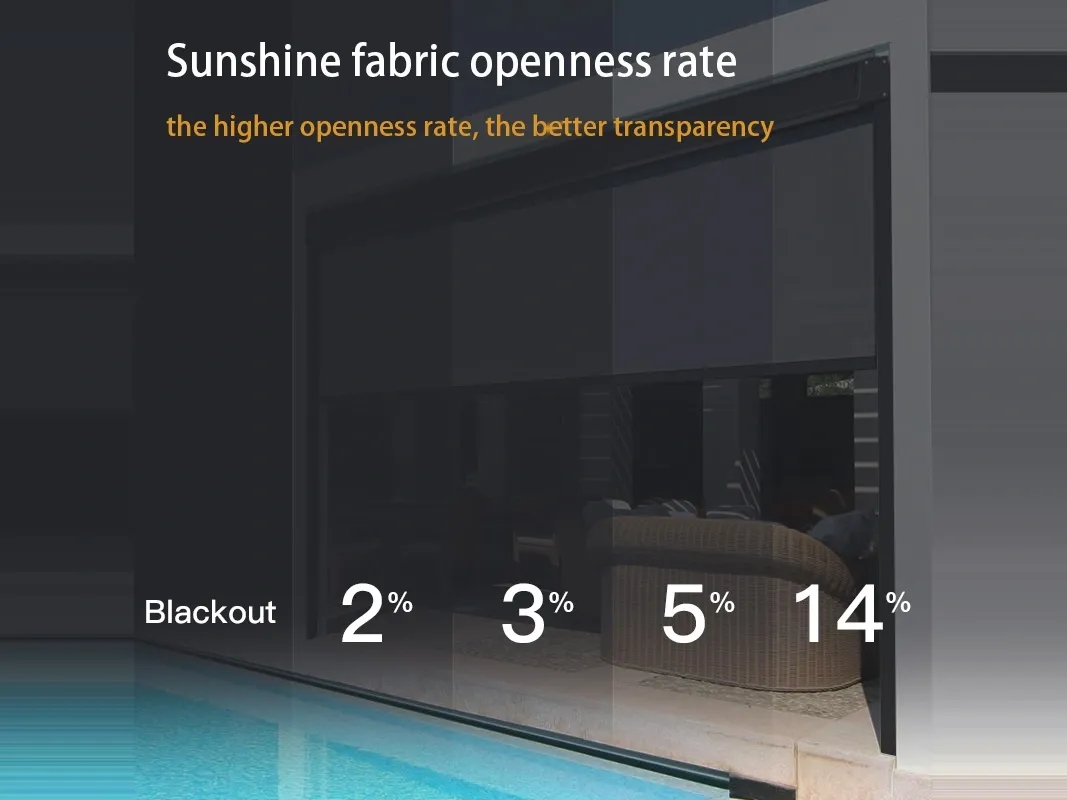
The same outdoor scene is pictured through all five grades. Blackout lets nothing through, for total privacy. At 2% and 3% a faint outline of the outside is visible, with glare strongly cut and daytime privacy kept. 5% is the balanced middle, and 14% is the clearest of the five, with the most daylight.
A 14% weave gives a near-clear view out and ample daylight, which suits view-led openings such as pergolas, patios and balconies. Welded zipper teeth running inside aluminium side tracks keep the fabric flat and tensioned across its width, rated to wind grade 10 for manual models and grade 8 for motorized models.
Fabric selection matrix
Specifiers pick an openness rate from the orientation of the opening, how much sun it takes, and how much view should be kept. For exposed elevations where glare and solar gain matter most, 3% is the usual choice. For covered terraces and other spaces where the view out matters more than maximum heat blocking, 5% is the common baseline.
Light transmission 0%. A fully closed composite weave that blocks all light and both sightlines, for bedrooms, meeting rooms and media spaces where nothing should show through.
Light transmission very low. Cuts almost all direct glare and solar heat while admitting faint daylight, for elevations that take hard low-angle sun.
Light transmission low to moderate. Filters strong sun and blocks a clear view in from outside during the day, while an outline of the outside stays visible to you.
Light transmission medium. The most widely specified grade: a clearer view out, effective glare reduction and comfortable ambient daylight during the day.
Light transmission high to medium. Noticeably sharper transparency and a brighter interior, for covered dining areas and shaded elevations.
Light transmission high. Minimal optical interference with the view while still cutting direct solar heat; interior silhouettes become visible from outside when lit at night.
Light transmission maximum. Keeps sightlines close to open air while still slowing wind and shading the opening.
Test videos
Seven short tests filmed the same way, so the grades can be compared directly: 0%, 1%, 3%, 5%, 10%, 20% and 30%.
0% openness (blackout): no light and no view in either direction, day or night.
1% openness: the densest screen weave here — almost all direct glare is cut, with only faint daylight and minimal view out.
3% openness: a tight weave for daytime privacy that still passes soft, even daylight.
5% openness: the balanced grade — clear outward view during the day together with real glare control.
10% openness: a more open weave that keeps the view out sharp and the interior bright.
20% openness: high transparency with abundant daylight. With interior lights on after dark, silhouettes may be visible from outside.
30% openness: the most open weave, keeping the view almost unobstructed while still cutting wind.
Openness rate FAQ
The questions buyers and installers ask most about screen fabrics.
For fabric samples or test reports, email raymond@eziptrack.com.