Sep 24, 2026Guides
Motorized vs Manual Outdoor Roller Blinds: How to Choose
Compare tubular motor with remote or Wi-Fi (TUYA), hand crank and cordless spring outdoor roller blinds, and pick the right drive for each opening.
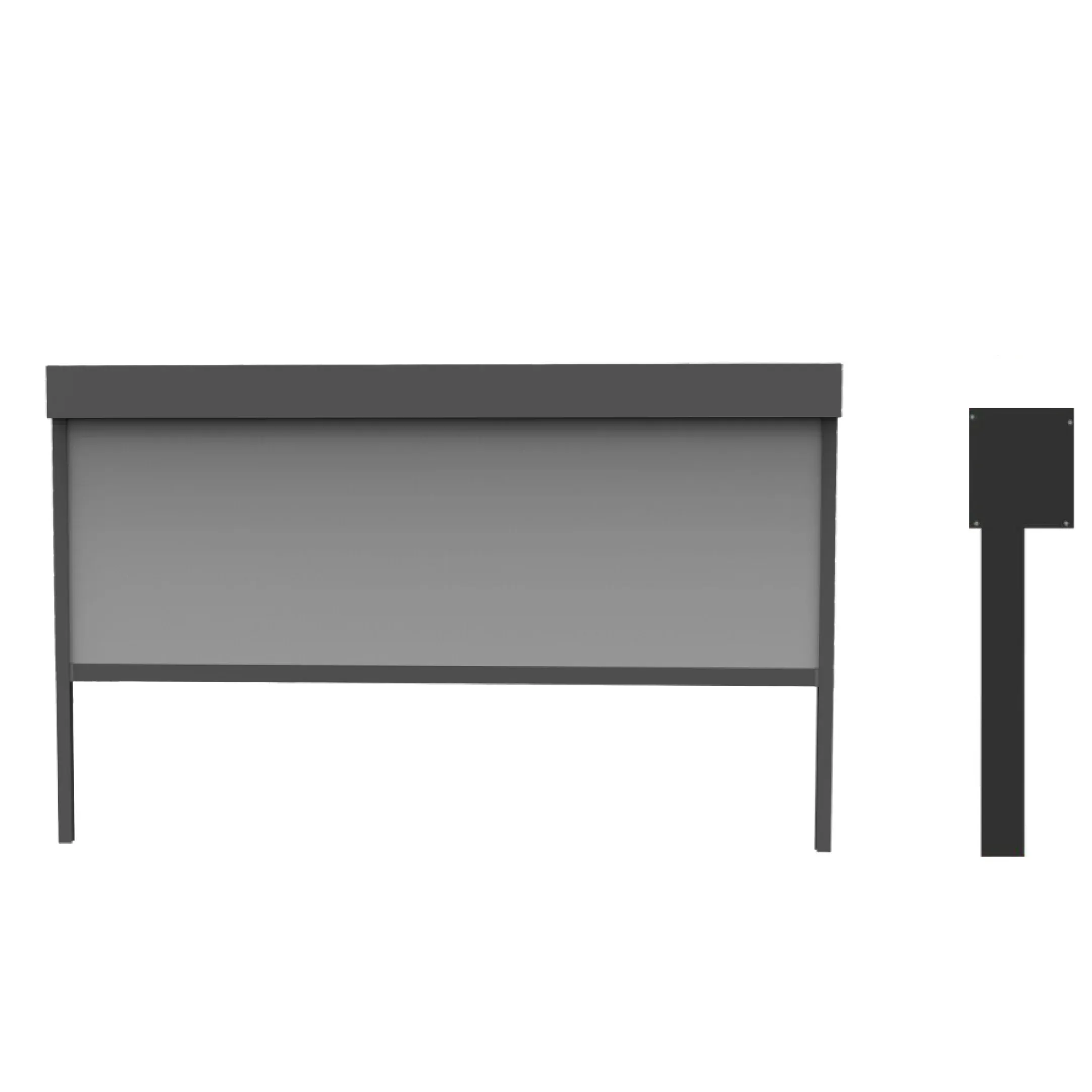
When comparing motorized vs manual outdoor roller blinds, choose motorized tubular motors for wide openings, high-frequency daily operation, or smart automation; choose hand crank systems for reliable, cost-conscious retrofits without electrical wiring; and specify cordless spring blinds for compact, high-traffic openings where dangling cords or crank handles present operational hazards.
Direct Answer: Which Outdoor Roller Blind Operating System Fits Your Project?
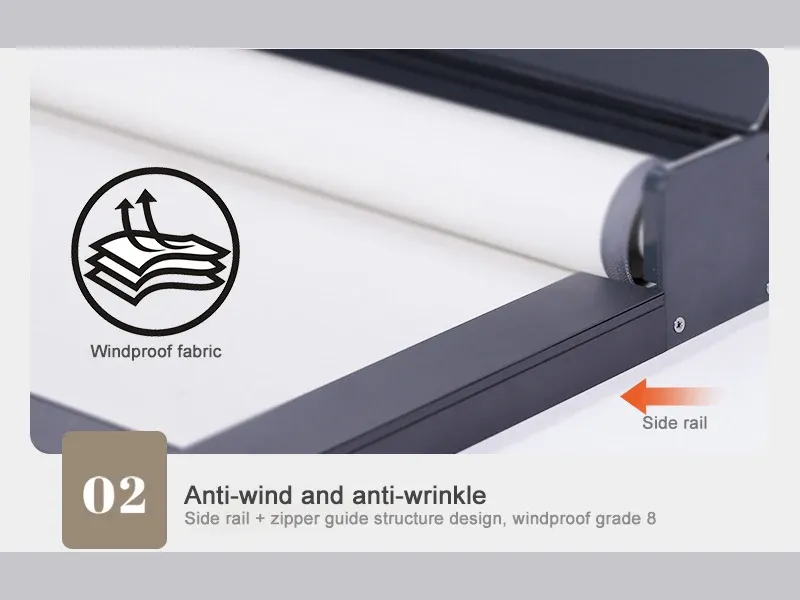
Exterior zipper-guided windproof roller blinds enclose balconies, pergolas, and hospitality patios against wind, rain, and solar glare. Unlike traditional loose-hanging screens, eziptrack systems feature welded zipper teeth along the fabric edges that slide inside heavy-duty aluminum side tracks. This continuous mechanical lock maintains fabric tension, delivering manufacturer-rated wind resistance Grade 8 for motorized and Grade 10 for manual models and high tear strength (warp ≥2650 N/5cm, weft ≥2450 N/5cm).
The four primary drive systems include:
- Motorized (Tubular Motor): Automated operation via an internal motor, controlled by an RF handheld remote or an optional Wi-Fi (TUYA) protocol.
- Double Layer Motorized: Dual-roller cassette pairing an independent solar view-through screen with a full blackout fabric.
- Hand Crank: Mechanical reduction gearbox driven by a detachable winding handle, requiring no electrical wiring.
- Cordless Spring: Manual counterbalance spring allowing rapid height positioning by grasping the bottom rail directly.
Decision Rule: Specify motorized tubular motors for openings wider than 3 meters, multi-blind facades, or high-frequency daily cycling; choose hand crank or cordless spring mechanisms for sites lacking electrical infrastructure or prioritizing mechanical simplicity.
Motorized Outdoor Roller Blinds: Tubular Motor with Remote and Smart Controls
Motorized outdoor roller blinds are the standard specification for modern residential verandas and commercial dining areas. The drive mechanism utilizes an internal tubular motor roller blind assembly concealed within the protective aluminum headbox. The motor rotates the aluminum barrel, gliding the fabric along the zipper retention tracks with push-button operation.
eziptrack manufactures motorized systems across five dedicated model series scaled by opening dimensions: the compact ZT90 Motorized Blind, the versatile ZT110 Motorized Blind, the intermediate ZT150 Motorized Blind, the ZT170 2-in-1 Motorized Blind, and the heavy-duty ZT180 Large Size Motorized Blind.
Key Advantages of Motorized Systems
- Multi-Blind Synchronization: A single operator can cycle multiple exterior blinds simultaneously, saving substantial labor across hospitality dining terraces.
- Handling Large Spans and Heavy Fabrics: High-torque tubular motors lift heavy exterior composite fabrics (30% Polyester + 70% PVC, 565 g/m² weight, 0.70 mm thickness) across roll widths of 200 cm, 250 cm, 300 cm, and 320 cm.
- Uniform Aesthetic Alignment: Electronic limit switches enforce repeatable stopping points, maintaining uniform bottom-rail sightlines across expansive facades.
Trade-offs and Constraints
- Electrical Rough-In Required: Requires dedicated AC power routing. Surface-mounted conduits are necessary for completed structures lacking junction boxes.
- Higher Hardware Investment: Incorporates precision motors, electronic receivers, and transmitters, increasing initial unit expenditure over manual hardware.
Handheld Remote vs. Wi-Fi (TUYA) Control: Operational Differences
- Multi-Channel RF Remote: Works over radio frequency, independent of any local network. It operates completely independently of local Wi-Fi or internet outages, providing reliable on-site control with dedicated individual and group channels.
- Wi-Fi (TUYA) Control Protocol: Functions as an optional control protocol connecting the motor to the local wireless network. Through the TUYA app, managers can schedule automated deployment during peak solar hours, control blinds remotely, and configure multi-blind zones.
Decision Rule: Specify motorized tubular motors whenever blinds are mounted above comfortable manual reach, across spans wider than 3 meters, or where coordinated multi-blind operation is required for hospitality venues.
Manual Option 1: Hand Crank Outdoor Blinds
A manual hand crank system replaces the internal motor with a mechanical reduction gearbox inside the cassette end cap. The operator rotates a detachable or articulated crank handle connected to a universal joint eyelet. When evaluating a hand crank vs motorized roller blind, crank mechanisms deliver mechanical reliability in locations where power supply is inaccessible.
Key Advantages of Hand Crank Systems
- Zero Electrical Rough-In: Installs directly onto masonry, steel columns, or timber framing without wiring, junction boxes, or electrician labor.
- Mechanical Independence: Operates reliably through power blackouts and network disruptions without electronic components.
- Economical Unit Sourcing: Eliminates motors, receivers, and controllers, reducing initial hardware procurement expense.
- Full Structural Rating: The Hand Crank Windproof Roller Blind utilizes the same heavy-duty side channels and welded zipper system as motorized versions, maintaining manufacturer-rated wind resistance Grade 10 integrity.
Trade-offs and Constraints
- Manual Cycle Time: Raising a 3-meter tall exterior screen takes noticeably longer than a push-button remote, which adds up across multiple openings.
- Physical Access Constraints: Operators must stand directly beneath the gearbox. Furniture or balustrades blocking the eyelet make manual winding awkward.
Decision Rule: Specify hand crank zip-track blinds when electrical wiring is structurally unfeasible or cost-prohibitive, and where blinds are operated only once or twice daily.
Manual Option 2: Cordless Spring Outdoor Blinds
The cordless spring mechanism utilizes an internal torsion spring housed inside the roller barrel. The spring is tensioned to counterbalance the weight of the fabric panel and weighted bottom rail.
To operate the Cordless Spring Manual Windproof Roller Blind, the user grasps the bottom rail handle and pulls down or pushes up. The counterbalanced spring holds the screen securely at any height along the side channels.
Key Advantages of Cordless Spring Systems
- Clean and Hazard-Free: Eliminates hanging crank rods, pull cords, and electrical leads, preventing snagging hazards in pedestrian pathways and preserving child and pet safety.
- Quick Repositioning: Allows repositioning with a single hand motion, faster than rotational crank winding.
- Silent Operation: Functions without motor noise or mechanical gear friction.
Trade-offs and Constraints
- Dimensional Range: The spring must balance a dense 565 g/m² composite fabric, so the cordless spring system covers catalogue openings from 1200 mm to 4000 mm wide and up to 3000 mm high.
- Direct Reach Required: The user must comfortably reach the bottom rail throughout its travel path, ruling out high transoms or installations behind balustrades, where the hand crank model covers widths from 500 mm.
Decision Rule: Specify cordless spring systems for ground-level, walk-through openings within the catalogue range (up to 3000 mm high) where rapid manual operation is needed and hanging crank handles would obstruct traffic.
Double Layer Motorized Blinds: Dual-Fabric Flexibility in a Single System
High-exposure terraces and premium commercial venues often face conflicting environmental demands: daytime heat and glare control without sacrificing exterior views, contrasted with nighttime visual privacy and blackout shading.
The Double Layer Motorized Windproof Roller Blind is the motorized model for openings where one fabric layer is not enough. It is listed with fabric light transmittance options including blackout, and covers catalogue sizes from 1 m to 4 m in width and up to 3 m in height.
Fabric Combination Logic
- Screen and blackout options: The model is specified with fabric light transmittance options that include blackout, so a single opening can be set up for shading and for full light block.
- Motorized control: Driven by an internal tubular motor with handheld remote and optional Wi-Fi (TUYA) control, so both the open and closed states are reached at the push of a button.
- Zipper-guided side channels: Like every eziptrack motorized model, the fabric edges run inside aluminium side rails with welded zipper retention, rated wind resistance Grade 8 (manufacturer-stated).
Decision Rule: Specify double layer motorized roller blinds when an outdoor opening requires both daytime solar heat reflection with outward visibility and nighttime total blackout or privacy, housed within a unified headbox.
Project-Based Selection Guide: Matching Systems to Applications
Use the following architectural guidelines to match drive mechanisms to common project types:
1. Residential Balconies and Verandas
For balconies with accessible power, ZT90 or ZT110 motorized blinds provide convenient daily shading. When stone cladding or masonry makes wiring impractical, Hand Crank Manual Blinds offer robust protection without surface damage. For walk-through balcony doors, the Cordless Spring Blind allows instant passage.
2. Restaurant Patios and Hospitality Outdoor Dining
Hospitality venues require swift weather responses. Cranking multiple manual blinds during sudden rain disrupts service and compromises dining comfort. Commercial dining terraces should standardize on motorized blinds with handheld remote or Wi-Fi (TUYA) control, so staff can deploy an entire perimeter from one master control.
3. Large-Span Commercial Glazing and High Openings
Openings approaching the catalogue maximum of 4 m wide by 3 m high generate significant fabric deadweight from 565 g/m² materials. Manual cranking across these dimensions causes fatigue and uneven fabric pull. These require heavy-duty motorized models like the ZT150 or ZT180 Large Size Motorized Blind, ensuring smooth torque distribution and structural stability.
4. Unwired Gazebos and Detached Pergolas
Freestanding garden structures often lack electrical conduits. Hand crank zipper blinds provide manufacturer-rated wind resistance Grade 10 weather protection without the expense of trenching underground power cables.
Decision Rule: Base operating system procurement on opening frequency, operator accessibility, and available power infrastructure rather than unit cost alone, as labor time and convenience dominate long-term client satisfaction.
Electrical and Structural Installation Considerations
Proper site preparation ensures trouble-free installation and operation.
Electrical Rough-In for Motorized Blinds
- Power Placement: Motorized tubular units require a dedicated AC power supply routed to the drive end of the cassette. In new construction, route wiring through structural framing before wall lining.
- Surface Retrofits: For existing masonry, route external UV-rated conduit directly to the headbox entry point. Detailed wiring layouts and mounting bracket options are documented in our outdoor blind installation guide.
- Signal Planning: RF remotes reliably penetrate exterior glazing and masonry. For the optional Wi-Fi (TUYA) control protocol, verify wireless coverage at the exterior perimeter.
Structural Anchoring and Track Alignment
All zip-track blinds rely on precision side-channel alignment. The 565 g/m² composite fabric (30% Polyester + 70% PVC, tear strength ≥2650 N/5cm warp, ≥2450 N/5cm weft) exerts lateral pull on side channels during wind exposure. Side tracks must be anchored into solid masonry, steel posts, or structural timber, maintaining strict plumb, level, and parallel alignment to prevent fabric binding or motor overload stops.
Decision Rule: Always verify electrical rough-in routing and junction box access before finalizing motorized blind orders; for fully finished surfaces without accessible power, default to manual hand crank or cordless spring mechanisms.
Frequently Asked Questions About Operating Systems
Can a manual hand crank outdoor blind be upgraded to a tubular motor later?
While mechanically possible, converting a hand crank blind to motorized post-installation is rarely practical. It requires replacing the internal roller barrel, removing the gearbox to install motor brackets, fitting the tubular motor, and routing new electrical wiring. Specifying the correct drive system during initial procurement prevents redundant site labor and hardware replacement.
Does the Wi-Fi (TUYA) control protocol replace the handheld remote?
No, the Wi-Fi (TUYA) protocol operates as an optional control layer alongside standard multi-channel RF remotes. The handheld remote provides immediate, zero-latency operation without internet dependency, while the TUYA app enables mobile adjustments, automation schedules, and multi-blind grouping over the local Wi-Fi network.
How do manual and motorized outdoor blinds compare in high-wind conditions?
Both manual and motorized eziptrack systems feature identical heavy-duty aluminum side tracks, welded zipper retention, and 565 g/m² composite fabric, delivering manufacturer-rated wind resistance Grade 8 for motorized and Grade 10 for manual models. The difference is operational: motorized blinds retract across an entire facade within seconds via remote, whereas manual blinds require winding each unit individually.
When should a contractor specify a cordless spring blind over a hand crank blind?
Specify cordless spring blinds for ground-level openings within the catalogue range where users need quick repositioning and where dangling crank rods would obstruct pedestrian traffic. Specify hand crank blinds for wider spans, taller heights, or installations where furniture prevents reaching the bottom rail.
Can double layer outdoor blinds be configured with manual hand cranks?
The Double Layer model is offered as a motorized system. It is listed with an internal tubular motor, so it is specified with electric control rather than a hand crank.
Decision Rule: Always evaluate retrofitting complexity during initial procurement; converting manual systems to motorized post-installation requires replacing the roller tube assembly, drive mechanism, and cassette end caps.
Can a zip screen blind be mounted directly to an outdoor pergola?
Yes. A zip screen blind mounts directly to aluminium or timber pergola posts, with the aluminium side tracks fixed vertically to the posts and the welded zipper edges running inside them so the screen stays taut. For wide spans, motorized models cover widths up to 5 m on the ZT150 and up to 14 m on the ZT180, while hand crank and cordless spring versions suit posts where no power is available.
What sizes can a windproof roller blind be made in?
Sizes depend on the model and the drive system. The ZT150 motorized blind covers widths from 0.85 m to 5 m with drops up to 5 m, and the ZT180 spans up to 14 m wide and 7 m high for large commercial openings. The Hand Crank manual model covers 500-4000 mm wide and 1500-3000 mm high; the Cordless Spring covers 1200-4000 mm wide and 0-3000 mm high.
Summary and Specification Support
Selecting the appropriate operating mechanism balances opening dimensions, cycling frequency, and site electrical infrastructure:
- Motorized Tubular Systems: Engineered for large spans, hospitality dining perimeters, and automated daily convenience. See the ZT90 to ZT180 motorized range.
- Double Layer Motorized: For openings that need shading plus a full blackout option in one motorized blind. See the Double Layer model.
- Hand Crank: Suited for unwired pavilions, historical facades, and budget-sensitive projects. See the Hand Crank model.
- Cordless Spring: Tailored for walk-through openings requiring quick manual operation and clean, cord-free aesthetics. See the Cordless Spring model.
Decision Rule: Standardize on motorized tubular systems for wide, high-visibility commercial areas, and utilize manual crank or cordless spring mechanisms for secondary unwired openings to optimize overall project cost.
To review complete technical drawings, cassette profiles, and mounting brackets for your upcoming project, explore our full outdoor roller blind catalog or submit your project schedule directly to our engineering team at Contact eziptrack or via email at
raymond@eziptrack.com.